Monsoon protection for aluminium windows and doors
Rain usually gets in through drainage, sealing and installation rather than through the frame. How we specify windows and doors for four months of near-continuous rain.
Belagavi gets nearly all of its rain between June and September, with rainfall figures ranging from about 985 mm to 1,329 mm depending on the station. Goa gets roughly 3,000 mm a year, with more than 90% falling in the same four months and July the wettest. Humidity stays high, and rain often arrives sideways.
A window that is fine for eight months can fail in the other four. The causes are rarely mysterious: water collects in a track and cannot drain, a joint at the wall edge was sealed with silicone alone, or a drain slot was blocked by plaster. The heavy monsoon rain guide explains the mechanism. This page is about what to specify and what to check.
A monsoon specification in four layers
Think of rain protection as four layers, each of which has to work. The system is the first. AluK publishes air and water tightness classes for its systems and test pressures in ASTM and EN terms. Where AluK Home India and in.aluk.com differ for a given system, we say so and confirm the figure against the datasheet for your configuration.
The other three layers are drainage, installation and maintenance. A tested system installed badly still leaks.
System: a tested water-tightness class, with the standard named
Drainage: sill slope, weep holes and a drainage path to outside
Installation: perimeter sealing, flashing and clearances measured on site
Maintenance: tracks and weep holes cleared before June
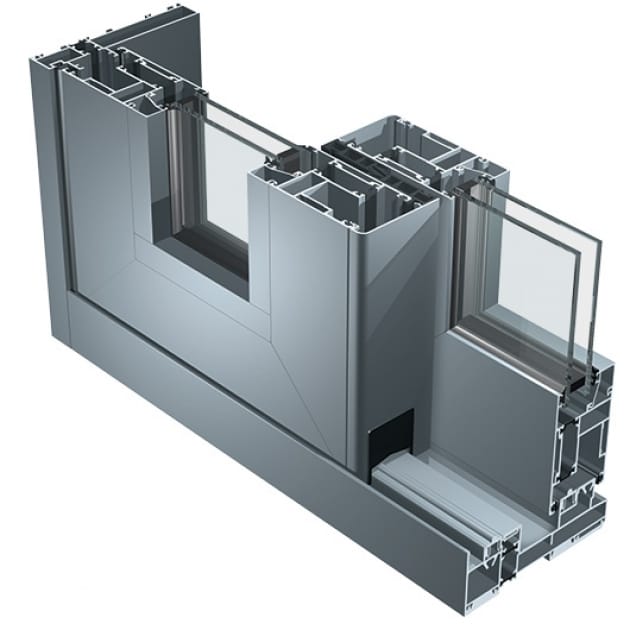
Cut sections of AluK systems that suit this kind of project. The right one depends on opening size, glass and exposure.
67IW thermally broken casement
A 67 mm thermally broken series for high thermal and acoustic performance, with burglary class RC2. AluK recommends it for replacing old wooden and PVC windows.
A water-tightness figure of 450 Pa, for instance, is the test pressure the unit resisted without water penetration under a stated method. Ask which standard and class the figure belongs to, and whether it applies to your size and glass.
Drainage is part of the design
Sliding frames use track channels and weep holes to drain collected water. Blocked drains are a common failure. SC45 adds a wider track and deeper gutter, which helps on exposed balconies.
Installation shapes the result
AluK itself lists installation gaps and weak sealing as causes of leaks. Clearances must allow for flashing, shims and sealant, and for out-of-square walls. Silicone alone does not do the job.
Overhangs and orientation
A deep overhang or a verandah can cut the water load more than a frame upgrade does. For west-facing walls in Goa that take wind-driven rain, consider outward-opening casements, which press into their frame in wind.
HOW TO DECIDE
Opening types and the monsoon
Every opening type can be made rain-tight with correct detailing, but they differ in how forgiving they are. Casements and fixed windows have the fewest joints. Sliding windows and doors depend on drainage. Folding doors have the most seams.
Exposed bedroom or stair window: casement or fixed glazing
Balcony slider in a sheltered position: standard sliding windows
Large terrace door facing the rain: lift and slide for compressed seals when closed
Folding wall on an uncovered terrace: add a canopy and check sill drainage
Ground-floor opening next to a drive or garden: check ground level and splash height
The pre-monsoon routine
In May, clear the tracks and weep holes of dust and plaster, rinse frames, check the seals and see that nothing blocks the drain slots from outside. Pour a bucket of water into the track and watch where it goes. If it pools, tell us before the rains begin, not after the first leak.
AluK’s care guidance also suggests checking handle screws once a year and lubricating locks and hinges lightly. In Belagavi, where winter is nearly dry, the pre-monsoon check is the one that matters. In Goa, repeat a quick check in mid-season.
Three questions to put in writing
What water-tightness class and which test standard
Ask for the datasheet for the system version you are being quoted.
How the sill drains
Ask for a drawing of the sill and drainage path, not just a description.
Who is responsible if it leaks
Ask what is covered after handover, for how long and who visits.
Monsoon-ready project sequence
Tell us the exposure
Which faces take driven rain and what overhangs exist.
Choose system and opening type
We recommend by exposure.
Site measurement and drainage detail
Clearances and sill drawn before fabrication.
Fabrication and install
Certified AluK Home partners fabricate; we coordinate installation and sealing.
First-monsoon check
Ask for a walk-through when the rain begins. Outside Belagavi arranged per project; confirm coverage.
Not by nature. Leaks usually come from blocked drainage, poor sealing or poor installation. A tested system, a drained sill and clear tracks are the answer.