Home / Guides / Thermal break aluminium windows: what the break
Thermal break aluminium windows: what the break does, what it does not, and when you need one
A plain explanation of the polyamide strip in an aluminium frame, the U-values AluK publishes, why glass matters more than the frame in a hot climate, and how to read a quote that says thermal break.
A thermal break slows heat moving through the frame. It does not control sun through the glass.
Aluminium conducts heat well. A frame cut from one continuous section carries heat from the outside face to the inside face with little resistance. A thermal break splits the frame into an outer and an inner aluminium shell and joins them with a strip of low-conducting polyamide, so the metal path is interrupted. That is the whole idea, and it is a sound one.
The answer depends on the room, the glass and the budget. In most Belagavi and Goa homes the biggest source of heat is sun through the glazing, which a thermal break does not address. It still matters for comfort at the frame, for air-conditioned rooms, and for comparing two quotes honestly, because a thermally broken system and a non-insulated one are different products at different prices.
Two aluminium shells and an insulating strip
The strip is usually polyamide, a polymer with good insulating properties, and it is mechanically locked into both shells so that the frame behaves as one structural piece. The inner shell stays closer to room temperature and the outer shell follows the weather. Industry explainers note that the benefit is greatest when the frame is paired with glazing designed to match, since a good frame around poor glass leaves the weak point where it was.
Thermal break is a frame feature, not a glass feature. Low-emissivity coatings, argon fill and spacer type belong to the insulating glass unit, which our window glass options guide explains. Think of the two as a pair: the frame sets how much heat moves through the metal, the glass sets how much comes through the opening.
See it in section
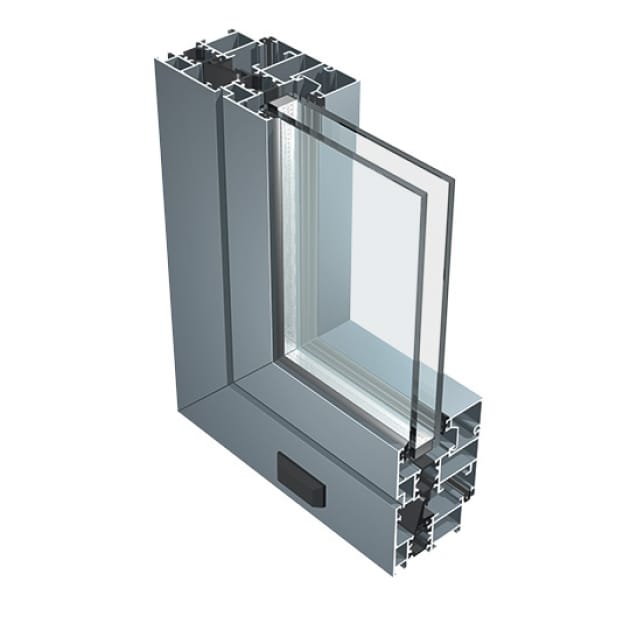
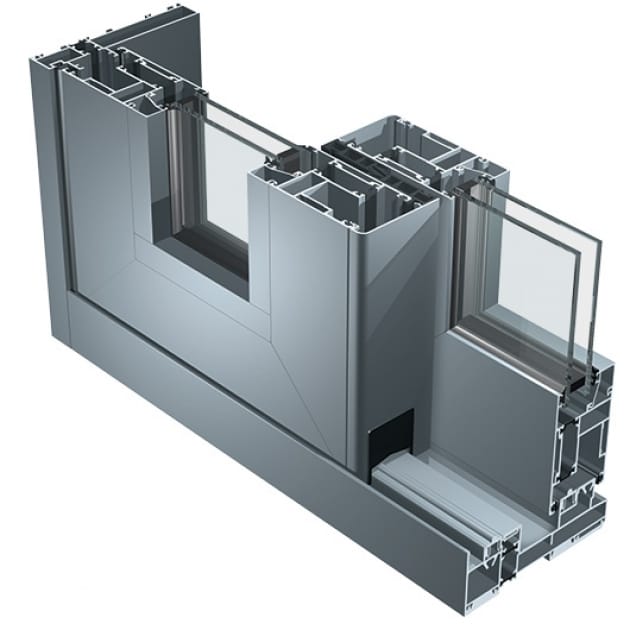
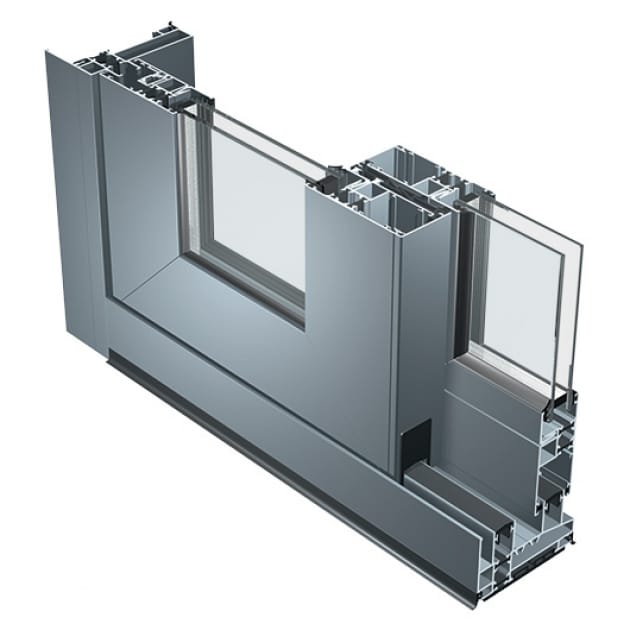
The systems discussed in this guide, cut away to show the profile.
67IW thermally broken casement
A 67 mm thermally broken series for high thermal and acoustic performance, with burglary class RC2. AluK recommends it for replacing old wooden and PVC windows.
Thermally broken and non-insulated versions of the same families
AluK offers many of its systems in both forms, and the datasheets say which is which. The labels to look for are TT or IW for thermally insulated and NI for non-insulated. The numbers below are manufacturer-stated and come from AluK Home and AluK India pages. Some are whole-window values with a stated glass, some are frame values, so treat them as indications and ask for the datasheet that matches your glazing.
Where a number is given for the frame alone, it is written Uf. Where it is for the whole window with a specific glass, it is Uw. The two are not interchangeable, and a quote that quotes a value without saying which is not telling you much.
Infineo sliding: 1.3 W/m2K shown on AluK Home, confirm for your glazing
Lift and slide TT: 1.4 W/m2K on AluK Home
SC140TT: Uw 1.7 with double glazing and 1.2 with triple, Uf 3.5
SC140NI non-insulated: Uf 7
67IW casement: Uw 1.4 double and 1.1 triple, Uf 2.4
56IW casement: Uw 1.7 double and 1.2 triple, Uf 3.5
45DS casement, non-insulated: Uf 7
CLIMATE
In a hot, humid climate, glass decides most of the heat
A common assumption is that thermal break is for cold countries. That is partly true. Low U-value matters most in cold climates, and the energy guidance from the US Department of Energy puts low solar heat gain first for hot ones. U-value measures conduction when there is a temperature difference. Solar heat gain coefficient measures how much of the sun’s energy gets through the glass. In Goa and the Karnataka coast, with west-facing glass in April and May, the second number is the one that makes a room hot.
A thermal break is not wasted in a warm climate, though. In an air-conditioned bedroom it reduces how much heat the metal frame conducts into the room, and it makes the inside face of the frame more comfortable to touch on a hot afternoon. If the room is not air-conditioned and the glass is heat-reflective, the frame is a smaller part of the story. Sort the glass first, then decide the frame.
When to choose thermally broken, and when non-insulated is fine
There is no rule that fits every opening. We use these criteria with customers, and we say clearly when the cheaper frame is the better decision.
Choose a thermally broken system when most of these apply:
The room is air-conditioned for long hours, such as a bedroom or a home office
The opening is large, so the frame carries a lot of metal across the elevation
You are specifying double or triple glazing and want the frame to match it
The facade is sun-exposed and frames get hot to the touch
The openings are on a high-spec villa or a building where thermal performance will be assessed
Where a non-insulated frame is a reasonable choice
Non-insulated sections suit utility openings, bathrooms, kitchens with strong natural ventilation, fixed openings in naturally ventilated spaces, and low-cost balcony enclosures where the room is not conditioned. AluK lists non-insulated lines such as SC95NI, S115NI and 45DS, and positions its SC40 value series for mass housing. Specifying a thermal break on a ventilation panel in a store room is cost with no return.
Where a customer is comparing aluminium and uPVC, the thermal break is what puts aluminium in the same conversation, because uPVC conducts less by nature. The slimline versus conventional guide covers the other side, which is sightline and span.
QUOTES
Four things to check when a quote says thermal break
Which system and which version
Ask for the series name with the TT or NI suffix. A quote that says aluminium sliding window with thermal break, and nothing else, can mean several different products.
Which U-value, measured how
Ask whether the figure is frame Uf or whole-window Uw, and for which glass build-up. A frame value quoted next to a different glass is not a window value.
The glass paired with it
Ask for the build-up in writing, for example 6 + 12 + 6, the coating and the spacer. The frame and glass are specified together, and the glass is where solar heat is controlled.
The finish and hardware
Thermal break strips do not change finish performance, but a dual-colour frame is common with thermally broken sections, so check that the exterior is a finish suited to your exposure. See the powder coating versus anodising guide.
Choosing a thermally broken system, step by step
List the openings and how each room is used
Mark which rooms are air-conditioned, which face west or south, and which are large. Utility openings go in a separate group.
Choose the glass first
Decide orientation, solar control and noise needs. The frame choice follows from the glass weight and size.
Match the series
We map each opening to a series at the showroom, with the TT or NI version stated.
Compare like for like
Put thermally broken and non-insulated quotes side by side, with identical glass, size and finish.
Confirm datasheets
Request the datasheet for the exact version and glazing, and keep it with your quotation.
A strip of insulating material, typically polyamide, that joins an inner and an outer aluminium section so heat cannot travel straight through the metal. It is built into the frame section at manufacture and cannot be added later.
Not for every opening. It helps most in air-conditioned rooms and large, sun-exposed frames. For ventilated utility openings a non-insulated frame can be right. Glass with suitable solar control usually matters more for heat than the frame.
We have no sourced figure for it on AluK systems. In general, a warmer inner frame surface reduces the chance of moisture forming on it, but humidity, ventilation and glass also decide. Ask for the technical sheet instead of relying on a general claim.
Usually, because the section is more complex. We do not quote generic prices. The cost difference depends on the series, size and finish, and a written quote with both options shows the actual gap for your openings.
Infineo, the lift and slide system, SC140, the Versatile sliding and casement ranges, and the 67IW and 56IW casements are listed with thermal break variants. The folding system is listed in non-insulated form on AluK India, so confirm which is offered for your project.
No. It is part of the profile design. An existing non-insulated window can gain from better glass, new seals or a secondary layer, but the frame section stays the same. Replacement is the only route to a thermally broken frame.
Ask for the series code, the version suffix, the Uf and Uw values with their glass assumptions, and the datasheet. See the aluminium windows page for the systems we show, then request a quote with your openings.