Home  /  Guides  /  Window glass

Window glass options explained: DGU, low-E, laminated and toughened

The four numbers worth asking for, how to choose glass by orientation, noise and safety, and how to read a glass build-up written on a quotation.

THE SHORT ANSWER

Choose glass by what each opening faces, then check the frame can carry it

For heat, look at SHGC first. For noise, look at laminated glass with unequal pane thicknesses. For safety on doors, low sills and large panes, look at toughened or laminated glass. Then check that the hardware and frame series are rated for the weight. Glass carries much of a window’s performance, and it is often the line left vague on quotations.
Our verdict: in Belagavi and Goa a double-glazed unit with a low-E coating on west and south openings is a good default for living spaces. Add laminated glass where there is road noise or a safety requirement. Do not spend on triple glazing or heavy acoustic builds unless a specific problem justifies it and the hardware is rated for the weight.

U-value, SHGC, visible light and sound rating

U-value is the rate of heat transfer in W/(m2K). Lower is better insulation. Frames and installation can be the weak points of a window, so ask whether a figure is for the glass centre or for the whole window. SHGC is a ratio from 0 to 1 of the solar radiation that passes through the whole window; lower means less solar heat gain. Wikipedia lists typical double glazing at 0.42 to 0.55 and triple at 0.33 to 0.47, and the figures on a given product can differ.
Visible transmittance is how much daylight passes. Tint and reflective coatings lower SHGC and often lower visible light too, so you trade daylight for heat control. Sound rating is shown as STC (ASTM) or Rw (ISO 717-1). They are single-number laboratory ratings over a frequency band, and they are not interchangeable. A whole-window rating depends on glass, frame and seals together.
Match the number to the problem. In a hot climate, SHGC matters most (US Department of Energy guidance); in a cold climate, U-value does. Belagavi and Goa are the first case.

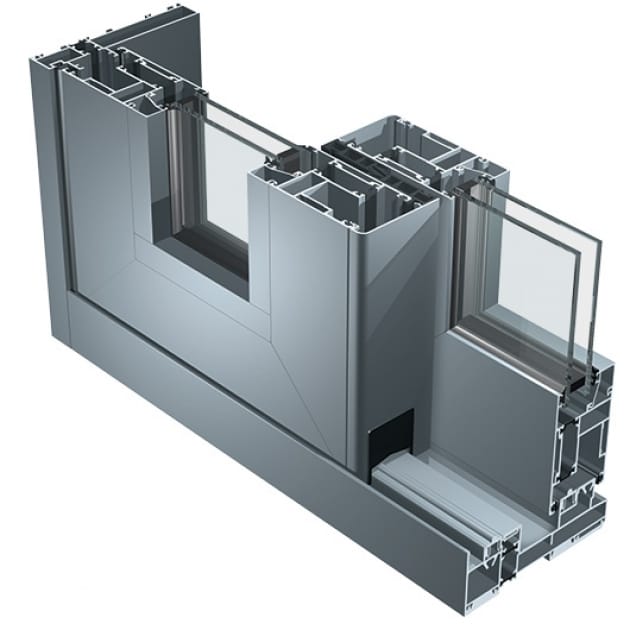
See it in section

The systems discussed in this guide, cut away to show the profile.

67IW thermally broken casement

A 67 mm thermally broken series for high thermal and acoustic performance, with burglary class RC2. AluK recommends it for replacing old wooden and PVC windows.
AluK SC140TT thermally broken sliding and lift and slide cross section

SC140TT thermally broken sliding and lift and slide

A 140 mm thermally broken system for sliding and lift and slide doors. Glass 10 to 40 mm, up to 300 kg per sash and 400 kg with a trolley.

How to read 6+12+6 and what the options do

An insulating glass unit (IGU) has two or more panes separated by a sealed gap. A quotation that says 6+12+6 means a 6 mm pane, a 12 mm gap and another 6 mm pane. Wikipedia gives typical pane thickness as 3 to 10 mm and an optimum centre gap of about 16 to 19 mm, with argon conducting about 67 percent as well as air. Warm-edge spacers reduce conduction and condensation at the edge. IGUs typically last 10 to 25 years, with warranties of 10 to 20 years.
AluK India lists single (SGU), double (DGU) and triple (TGU) glazing, laminated glass, and low-E or reflective glass for sun-facing openings. Its Versatile casement supports glazing from 5 to 40 mm. That range tells you the frame can carry thick acoustic or laminated builds, not that every build is a good idea.

SAFETY GLASS

Toughened, laminated and when each one applies

Toughened (tempered) glass is about four times stronger than annealed glass and breaks into small granular pieces. It cannot be cut or drilled after toughening, so sizes must be final before the order. Nickel sulfide inclusions can cause rare spontaneous breakage. Laminated glass bonds layers with an interlayer, holds together when broken, reduces sound transmission compared with a single pane of equal thickness, and its interlayer can block nearly all UV.
Many openings use laminated toughened combinations. For doors, low sills and large panes, safety glass is the right default. In India, safety glass for buildings falls under IS 2553 (Part 1), and glass selection is covered by the code of practice IS 16231; confirm current editions on the BIS portal. Our noise-reducing windows page and fixed window page show where laminated and large-format glass are used.

Glass by orientation, noise and room

Use this as a starting point and confirm on site.

Glass weight decides the hardware

Float glass weighs about 2.5 kg per square metre for each millimetre of thickness, so 6+12+6 is about 30 kg per sq m and 8+16+8 about 40 kg per sq m. A 2 m by 2.4 m panel in the thicker build is about 190 kg of glass before the frame. That has to match the sash load rated for the series, which is why the glass should be fixed before the system is. The sliding vs lift and slide guide works through this for doors.
Glass is also a large share of the price on bigger openings. See the price guide for how glass choice changes a quotation.

MISTAKES

Glass mistakes that show up after installation

Tint added without checking numbers

A darker tint can cut daylight more than it cuts heat. Ask for SHGC and visible transmittance of the actual build.

Centre-of-glass figures read as whole-window figures

A glass sheet’s U-value is better than the window’s, because frames and edges conduct more. Ask which a figure refers to.

STC and Rw mixed up

They come from different test methods. Compare like with like, and ask for the whole-assembly report.

Heavy glass on light hardware

Thick laminated builds in a series rated for a lighter sash cause sticking and wear. Settle glass first, then series.

FAQ

Window glass questions

Plain answers for homeowners and architects.
How easily heat passes through the window. Lower is better. It matters most where you need to keep heat in or out across a large temperature difference, and less in a warm climate than SHGC does.
It is the fraction of the sun’s heat that gets through the whole window. In hot climates a lower SHGC is generally preferred, especially for west-facing openings. AluK recommends low-E or reflective glass for sun-facing openings.
It reduces heat transfer and noise compared with single glass. The benefit depends on coatings, gas fill, gap and frame. For living spaces it is usually worth it; for small utility windows it may not be.
Toughened is stronger and breaks into granules. Laminated holds together when broken and helps sound and security. Many openings use laminated toughened combinations. Choose by purpose and ask for the build-up.
Usually yes, but the whole assembly counts. Laminated glass, unequal pane thicknesses, seals and installation all contribute. Ask for a test report for the assembly.
As a written build-up such as 6+12+6, with coating type, spacer type and whether panes are toughened or laminated. If it says only ‘DGU’, ask for the rest.

Related

Noise-reducing windows

Product page.

Fixed windows

Large panes.

Price guide

Cost factors.

Request a quote

Share your project.

Not sure which glass your west wall needs

Send photos, the facing direction and sizes through the quote form, or ask at the showroom to compare glass samples.