Home  /  Guides  /  Windows for Goa

Windows for Goa's climate: what the weather does and what to specify

Over 90% of Goa’s rain falls in four months, the air carries salt well inland, and May passes 35 C. This guide turns those facts into a specification checklist you can hand to any supplier.

THE SHORT ANSWER

A good Goa window is decided by the lines on the quotation

Goa asks three things of a window: keep out driven rain for four months, survive salt-laden air, and stay usable when the afternoon sun is on the glass. Aluminium can do all three, but only if the finish, hardware, drainage, gaskets and glass are specified in writing. The frame material on its own tells you very little.
Verdict: for most Goa homes, a thermally broken aluminium system with a coastal-grade finish, stainless hardware, a drained sill and solar-control glass on west and south faces is a sound specification. Near the open sea, treat the finish certificate and the rinse routine as part of the purchase. If you want the commercial view of coastal projects, see our coastal homes solution page; this guide is the reasoning behind the checklist.

What Goa's weather actually looks like

Goa has what the Koeppen scheme calls an extreme tropical monsoon climate. More than 90% of annual rain falls between June and September, and the annual total is usually quoted as roughly 3,000 mm (sources differ between 2,926 and 3,048 mm, so treat it as a round figure). July is the wettest month at about 995 mm in the state climate table.
At the Panaji station, July also brings about 27 rainy days and relative humidity of around 87%. Across the year there are roughly 97 rainy days. The Goa government’s climate page puts May as the hottest month, with daytime temperatures above 35 C and high humidity, and monsoon arriving by early June.
Belagavi, where our showroom is, is a useful contrast. It is about 50 km from the Goa border and 100 km from the Arabian Sea, with annual rainfall of about 1,329 mm. A window specification that is comfortable in Belagavi can be under-specified on the Goa coast, which is why we do not reuse one checklist for both.

See it in section

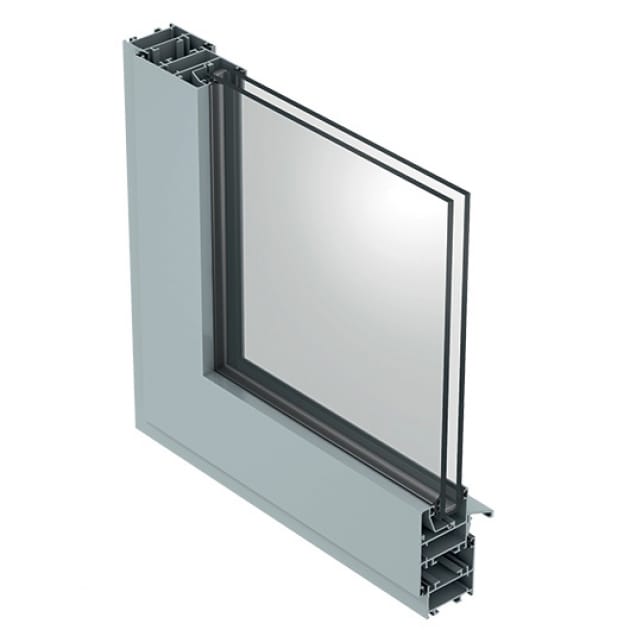
The systems discussed in this guide, cut away to show the profile.
AluK 45DS casement system cross section

45DS casement

A 45 mm non-insulated casement system AluK positions for tropical and hot climates, with squared or rounded glass beads.

67IW thermally broken casement

A 67 mm thermally broken series for high thermal and acoustic performance, with burglary class RC2. AluK recommends it for replacing old wooden and PVC windows.

SC45 sliding window

A slim non-insulated sliding window with a 33 mm visible interlock, glass up to 24 mm and a deeper gutter for drainage. Up to 120 kg per sash.

Goa is not one exposure, so do not write one specification

Goa has about 103 km of coastline, and the Mandovi and Zuari estuaries and their creeks bring salt-laden humid air well inland of the open beaches. A house on a creek in Bardez can see more salt than an apartment two streets back from a beach.
Sort your openings into three groups before choosing anything:

SPECIFICATION CHECKLIST

Four things to write down before you compare quotes

Finish: ask for the class and the certificate

Aluminium does not rust like steel, but salt attacks the coating and the fittings. Coating suppliers publish stricter pre-treatment for seaside use, for example the Qualicoat Seaside class. AluK says high-resistance finishes for aggressive environments are available on request. Ask which class applies to your exact colour and get the certificate.

Hardware, screws and gaskets

Indian coastal window guides commonly call for stainless-steel hardware and screws and EPDM gaskets near the sea. Do not assume it. Ask for the hardware brand, the material of rollers and fasteners, and whether the gasket is replaceable. Weak fittings are a common failure point on coastal windows.

Drainage and sill design

Sliding tracks collect rain and must drain through weep holes that are sized and positioned for the system. Ask to see the drainage path on a cut section or a full-size unit. A window that is tight on a dry day but has no way to shed water is a monsoon problem.

Glass for heat control

West and south faces take the afternoon sun. Look first at solar heat gain (SHGC) and whether the glass is low-E or reflective. AluK lists low-E and reflective glass for sun-facing openings. Our glass options guide explains the numbers and what to write on the quote.

Aluminium or uPVC in Goa: an honest comparison

Some guides recommend uPVC for Goa, and that is a fair position for small openings on the open coast, because uPVC does not corrode and conducts little heat. We sell aluminium, so weigh this with that in mind.
Aluminium earns its place where openings are large, where slim frames and big glass panels matter, or where a sliding or folding wall is wanted. A thermal break and suitable glass bring heat performance into range, and a documented coastal finish handles the salt. For openings that are small, sheltered and low in the building, uPVC can be a perfectly reasonable choice. The longer comparison is in aluminium vs uPVC windows.
Whichever you pick, compare like with like: a thermally broken, double-glazed aluminium quote set beside a single-glazed non-thermal one is not a material comparison.

Choosing sliding, casement or fixed for a rainy coast

Sliding windows suit balconies and wide openings, but the track is the weak point in heavy rain, so drainage and cleaning access matter. Casement windows seal by compression and often cope better with wind-driven rain, and an outward-opening sash can stay open a crack in a shower. Fixed glass has no moving parts and is the most weatherproof, so use it where you want light and a view but not airflow.
One workable pattern for Goa is fixed glass for the view, a small casement for ventilation and a sliding door only where you need a wide opening to a deck or garden. Our casement windows and sliding windows pages show the AluK ranges, and the monsoon rain guide goes deeper on leaks and tightness classes.

MAINTENANCE

A simple care routine that protects the finish

Rinse, do not scrub

AluK India says warm water and household detergent a few times a year is enough, with no repainting. Near the sea, coating suppliers publish shorter intervals, from every three to six months on a high-salt coast to 12-18 months on a low-salt coast. Use a soft cloth and avoid abrasives or solvents.

Clear the drains before June

Before the monsoon, clean the sliding tracks and check that every weep hole is open. Blocked drains are a commonly cited cause of leaks. After the rains, rinse salt and silt out of the track and look at gasket corners for mould.

Service hardware once a year

Check handle screws without overtightening, wipe the track, and lubricate locks and hinges lightly, wiping off any excess. For a holiday home left empty through the monsoon, do this routine before you lock up. Our maintenance guide has a fuller list.

Heritage houses and coastal zones: confirm before you design

Goa’s older houses and its coastal strip can carry planning restrictions. Panchayat construction licences are issued after clearance from the Town and Country Planning department, and its Conservation Committee reviews heritage-related proposals. Coastal zone rules have a no-development strip near the high tide line, and the status of the newer coastal plan has been unsettled.
We are not a planning authority and do not give legal advice. For a Portuguese-era house or a plot near the water, check the position with the relevant authority (TCP, the panchayat or municipality, and the coastal zone authority) before you order, and tell us if slim frames or colour matching are a condition of approval.
If your house is in or near Panaji, see our Panaji page; for the wider picture of how we work in the state, see aluminium windows and doors in Goa.

How a Goa enquiry works with us

Send drawings and photos

Share elevations or opening sizes, photos of each facade and the direction it faces. Tell us how close you are to the sea or a creek and whether the house is occupied year-round.

Visit the Belagavi showroom or request a call

Our AluK Home showroom in Tilakwadi has full-size sliding, folding and casement units to operate. If you cannot travel, we can review by phone and WhatsApp first.

Site measurement, arranged per project

Measurement is done on site by the fabricating partner. For Goa we arrange visits per project, so please confirm coverage for your location when you enquire.

Written specification and quotation

You receive a quote that states system, finish, glass build-up, hardware, scope of installation and taxes, so that you can compare it line by line with any other offer.

FAQ

Questions about windows for Goa

Short answers, with the reasoning behind them.
Aluminium does not rust the way iron does, but salt can attack the coating and the fittings. A suitable finish class, stainless hardware and a regular rinse prevent most problems. AluK offers high-resistance finishes for aggressive environments on request, so ask for the certificate for your colour.
Start with solar heat gain (SHGC): a lower figure means less sun heat comes through. AluK lists low-E and reflective glass for sun-facing openings. Ask for the full glass build-up in writing, for example 6+12+6 for a double-glazed unit, with the coating named.
A sliding window leaks when its drainage is blocked or poorly detailed, or when it is badly installed. Choose a system with published air and water tightness classes, confirm the sill drains, and keep the weep holes clear. See our monsoon rain guide for the checks.
Coating suppliers suggest every three to six months on a high-salt coast and every 12 to 18 months where salt is low. Rinse with fresh water and a soft cloth. Follow the care instructions for your own finish, and keep them with the warranty papers.
Often yes, but permission may be needed, especially for listed or conservation-area buildings. Check with TCP and your panchayat or municipality first. Slim aluminium sections and dark or earth colours are commonly used in such houses, but approval depends on the authority.
We are based in Belagavi and arrange Goa projects per project, with fabrication through certified AluK Home partners. Coverage depends on location and scope, so confirm it when you send your details. We do not have a Goa showroom.
It is not mandatory. It reduces heat transfer and noise compared with single glass, and the benefit grows with low-E coatings and sealed frames. For west-facing living rooms and bedrooms near a road, it is usually worth pricing. For a small sheltered utility window it may not be.

Related

Coastal homes

Solution page.

Goa

Our Goa coverage.

Monsoon protection

Rain performance.

Request a quote

Share your project.

Bring your Goa elevations and we will write the specification with you

Send opening sizes, facade photos and your distance from the sea through the quote form, call +91 89704 69999, or visit the showroom in Tilakwadi, Belagavi.